- Platform Overview
- Content Creation Tools
- Algorithm and Discovery
- Monetization Opportunities
- Influencer Opportunities
- Challenges and Criticisms
- Pros and Cons
- Recommendations for Creators
- YouTube Advertising Vs TikTok Advertising
- Future Outlook
- Closing Thoughts
- Frequently Asked Questions
- Key Takeaways
If you’re ready to turn your passion for creating content into a lucrative side hustle, this blog post is your golden ticket. Today, we’ll dive into the world of monetizing your online presence on TikTok and YouTube. From sponsorship deals to ad revenue strategies, we’ve got all the insider tips to help you start cashing in on your creativity and share your YouTube content with the community. Get ready to learn how to leverage your followers, engagement levels, share, YouTube content, TikTok content like a pro. It’s time to transform those endless hours spent online into a profitable venture.
So, grab a seat and get ready for some game-changing insights that will take your social media game from amateur to influencer status in no time!
Platform Overview
TikTok Features
TikTok is a popular platform for creating and sharing short videos. Users can showcase their creativity through lip-syncing, dancing, or comedy skits. The platform offers various filters, effects, and soundtracks to enhance videos.
- Pros:
- Easy-to-use interface
- Wide reach among younger audiences
- Cons:
- Limited video length
- Algorithm challenges for new creators
Many users engage with TikTok due to its addictive “For You” page that shows a tailored feed based on user preferences. This feature helps content creators gain exposure quickly.
YouTube Features
YouTube is a video-sharing platform where users can upload, view, and comment on videos. Creators have the flexibility to produce long-form content such as tutorials, vlogs, or music covers.
- Pros:
- Monetization options like ads and memberships
- Diverse audience demographics

- Cons:
- High competition
- Need for consistent quality content
One of the key features of YouTube is its search engine optimization (SEO) capabilities that help videos reach a broader audience through relevant keywords and tags.
Audience Demographics
TikTok primarily attracts a younger demographic aged between 16 to 24 years old who enjoy engaging with short-form entertaining content. On the other hand, YouTube has a more diverse age range but tends to attract an older audience compared to TikTok.
- Key Information:
- TikTok: Younger audience base
- YouTube: Diverse age groups
Both platforms offer unique opportunities for individuals looking to make money online by leveraging their creative skills in different ways tailored to each platform’s specific features and audience demographics.
Content Creation Tools
TikTok Editing
TikTok offers a range of editing tools to help users create engaging content. From adding music and effects to adjusting playback speed, TikTok provides various features to enhance videos. Users can also use filters, stickers, and text overlays to make their content more visually appealing.
One advantage of using TikTok for editing is the simplicity of its interface. It makes it easy for beginners to create professional-looking videos without much technical knowledge. TikTok’s algorithm favors creative and high-quality content, increasing the chances of gaining followers and potentially monetizing one’s account.
- Pros:
- User-friendly interface
- Wide range of editing features
- Algorithm supports creative content
- Cons:
- Limited video length
- Competition from other creators
When creating content on YouTube, the platform offers robust editing tools through YouTube Studio. Users can trim videos, add transitions, incorporate music from the audio library, and include end screens and cards for interactivity with viewers.
YouTube’s editing capabilities allow creators to produce polished videos that cater to their target audience effectively. Moreover, YouTube provides analytics that offer insights into viewer demographics and engagement metrics essential for optimizing future content strategies.
- Pros:
- Advanced editing features
- Detailed analytics
- End screen options
- Cons:
- Steeper learning curve compared to TikTok
Algorithm and Discovery
TikTok Algorithm
TikTok’s algorithm is designed to promote engaging content. The platform uses a combination of factors to determine what videos users see on their “For You” page. For instance, the amount of time users spend watching a video affects its visibility. TikTok considers user interactions like comments, shares, and likes.
Understanding the TikTok algorithm can help creators tailor their content for maximum reach. By creating videos that captivate viewers early on and encourage interaction, creators can increase their chances of going viral. Utilizing popular sounds or challenges can also boost visibility as these trends are often favoured by the algorithm.
YouTube Algorithm
YouTube’s algorithm focuses on viewer satisfaction. It assesses metrics such as watch time, click-through rate, engagement, and relevancy to suggest videos to users. Creators who produce high-quality content that keeps viewers engaged are more likely to have their videos recommended by YouTube.
To succeed on YouTube and make money through the platform, creators need to understand how the algorithm works. Encouraging viewers to watch videos until the end can improve watch time metrics which in turn boosts visibility. Collaborating with other YouTubers or leveraging trending topics can also positively impact a video’s performance in terms of discovery and audience reach.
Monetization Opportunities
TikTok Earning Potential
If you’re considering using TikTok to make money, there are various avenues to explore. One popular method is through brand partnerships, where companies pay you to promote their products or services in your videos. For instance, if you have a large following and engage with your audience effectively, brands may reach out to collaborate with you. Another way is through the TikTok Creator Fund, which allows creators to earn money based on video views and engagement metrics.
Moreover, leveraging affiliate marketing on TikTok can be lucrative. By sharing unique links in your videos that direct viewers to purchase products or services from partner companies, you can earn a commission for each sale made through your referral link. Hosting live events on TikTok through features like Live Gifts enables fans to send virtual gifts during your livestreams that can be converted into diamonds and later exchanged for cash.
- Brand partnerships
- TikTok Creator Fund
- Affiliate marketing
- Live events and virtual gifts
YouTube Earning Potential
Content creators have diverse options available. One of the most common methods is through Google AdSense, where ads are displayed before or during videos, providing revenue based on factors like ad engagement and viewer demographics. By consistently creating quality content that attracts a substantial viewership base, YouTubers can generate significant income from ad revenue alone.
Furthermore, sponsored content collaborations present another opportunity for earning on YouTube. Brands often approach successful channels for paid promotions within their videos or as dedicated sponsorships. Creators might also consider selling merchandise related to their channel’s theme as an additional stream of income by offering items such as branded clothing or accessories directly to their audience.
Influencer Opportunities
TikTok Collaborations
Collaborating with brands on TikTok can be a lucrative opportunity for influencers. By partnering with companies, creators can promote products or services to their audience, earning money through sponsored content. These collaborations often involve creating engaging and creative videos that showcase the brand in a positive light. For instance, a fashion influencer might team up with a clothing brand to feature their latest collection in a fun and stylish TikTok video.
One of the benefits of TikTok collaborations is the potential for exposure to a large and diverse audience. When influencers work with brands, they can reach new followers who may not have discovered them otherwise. These partnerships can lead to increased credibility and trust among followers since they see the influencer endorsing products they believe in. On the downside, some influencers may find it challenging to maintain authenticity when promoting sponsored content excessively.
YouTube Partnerships
YouTube partnerships offer creators various ways to earn money beyond ad revenue. By collaborating with brands or joining affiliate programs, YouTubers can generate income through sponsored videos or product placements within their content. These partnerships allow creators to monetize their channel while providing valuable exposure for businesses looking to reach YouTube’s vast user base.
An advantage of YouTube partnerships is the flexibility they offer in terms of content creation and monetization strategies. Creators have the freedom to negotiate deals that align with their interests and values while also diversifying their revenue streams outside of traditional advertising methods. However, one challenge influencers may face is maintaining transparency with their audience regarding sponsored content without compromising viewer trust.
Challenges and Criticisms
TikTok Content Monetization
Creating content on TikTok can be fun, but turning that into a revenue stream comes with challenges. One of the main criticisms is the platform’s limited options for monetization. Unlike YouTube where creators can earn from ads, sponsorships, and merchandise sales, TikTok primarily relies on its Creator Fund and brand partnerships for monetization.
The pros of TikTok include a vast audience reach and virality potential due to its algorithm. However, some cons involve the difficulty in converting views into revenue directly through the platform itself. For instance:
- Pros: Large audience base
- Cons: Limited direct monetization options
YouTube Payment Systems
On YouTube, creators have more established payment systems available compared to TikTok. They can earn money through Google AdSense by displaying ads on their videos or receive channel memberships and Super Chats during live streams. This variety allows YouTubers to diversify their income streams beyond just one source.
One advantage of YouTube’s payment systems is the ability for creators to build a sustainable income over time through various revenue streams like ad revenue, memberships, and merchandise sales.
- Pros: Diverse income sources
- Cons: Competition leading to lower CPM rates
Pros and Cons
Advantages of TikTok
TikTok offers a vast audience potential, with over 800 million active users worldwide. Creators can quickly gain popularity through trending challenges and viral content. The platform’s algorithm promotes discoverability, giving new creators a chance to go viral overnight.
Moreover, TikTok provides various monetization options for creators. From brand partnerships to the Creator Fund, there are multiple ways to earn money on the app. For instance, popular TikTokers receive sponsorships from companies looking to reach younger audiences.
- Vast audience potential
- Quick path to popularity through trends
- Diverse monetization opportunities like sponsorships and the Creator Fund
Disadvantages of YouTube
YouTube has a high level of competition due to its massive user base and established creators. Standing out on YouTube requires consistent content creation and quality production values. The platform’s monetization policies can be stringent compared to other platforms.
Furthermore, YouTube’s algorithms sometimes favour longer videos over shorter ones for ad revenue purposes. This preference might pose challenges for creators who prefer creating short-form content or those aiming for quick engagement with their viewers.
- High competition among established creators
- Need for consistent high-quality content
- Algorithms may prioritize longer videos over short ones
Recommendations for Creators
Choosing the Right Platform
When deciding between TikTok and YouTube to make money, consider your content style. TikTok is great for short, trendy videos while YouTube suits longer, informative content. Think about your target audience too; younger viewers might prefer TikTok’s quick clips.
Another aspect to ponder is monetization options. While both platforms offer revenue opportunities, they differ in their approaches. On TikTok, creators can earn through gifts from viewers or brand partnerships, whereas YouTube allows monetization through ads, memberships, and merchandise sales.
In terms of engagement and virality potential, TikTok often offers quicker growth due to its algorithm that pushes new content to a wider audience faster than on YouTube. However, building a loyal subscriber base on YouTube can lead to more consistent income over time compared to the fluctuating earnings on TikTok.
- Consider your content style
- Think about your target audience
- Evaluate monetization options available on each platform
- Compare engagement and virality potential between TikTok and YouTube
Monetization Strategies
On TikTok, one effective strategy is leveraging trends by creating relevant content quickly before it saturates the platform. This approach increases visibility as users actively seek out trending challenges or topics daily. Collaborating with other creators can also broaden your reach by tapping into their follower base.
For YouTube, focusing on search engine optimization (SEO) is key to attracting organic traffic over time. Tailoring video titles, descriptions, and tags around popular keywords improves visibility in search results which translates into more views and ad revenue. Diversifying income streams by offering exclusive perks through memberships or selling branded merchandise enhances overall earnings stability.
- Leverage trends for quick content creation
- Collaborate with other creators for broader reach
- Focus on SEO tactics for long-term organic traffic growth
- Diversify income streams through memberships and merchandising
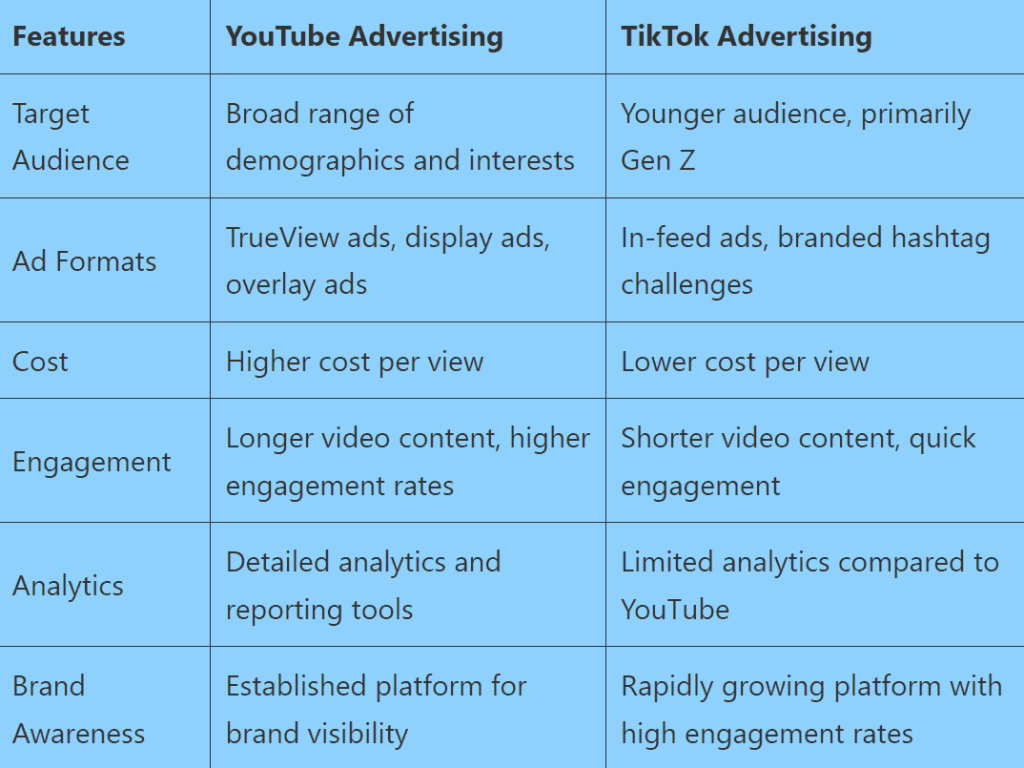
YouTube Advertising Vs TikTok Advertising
| Features | YouTube Advertising | TikTok Advertising |
| Target Audience | Broad range of demographics and interests | Younger audience, primarily Gen Z |
| Ad Formats | TrueView ads, display ads, overlay ads | In-feed ads, branded hashtag challenges |
| Cost | Higher cost per view | Lower cost per view |
| Engagement | Longer video content, higher engagement rates | Shorter video content, quick engagement |
| Analytics | Detailed analytics and reporting tools | Limited analytics compared to YouTube |
| Brand Awareness | Established platform for brand visibility | Rapidly growing platform with high engagement rates |
Pros and Cons:
YouTube Advertising:
- Pros:
- Extensive reach to a diverse audience
- Detailed targeting options
- High-quality video production
- Cons:
- Higher costs compared to TikTok
- Increasing competition for ad space
TikTok Advertising:
- Pros:
- Lower cost per view
- High engagement rates among younger users
- Trend-driven content opportunities
- Cons:
- Limited analytics and reporting tools
- Smaller audience compared to YouTube
Differences:
- YouTube caters to a wider demographic while TikTok focuses on a younger audience.
- YouTube offers various ad formats, whereas TikTok is known for in-feed ads and challenges.
- YouTube provides detailed analytics, but TikTok has limited reporting tools.
- YouTube is established for brand awareness, while TikTok is rapidly growing with high engagement rates.
Comparing YouTube and TikTok Advertising
When comparing YouTube and TikTok ads in terms of conversion rate, it ultimately depends on the target audience and the nature of the product or service being advertised.
YouTube ads are known for their ability to reach a wide audience due to the platform’s extensive user base and diverse content offerings. This can be advantageous for products or services that appeal to a broad demographic. Additionally, YouTube allows for longer-form video ads, which can provide more in-depth information to viewers.
On the other hand, TikTok ads are popular among younger audiences who are more engaged and receptive to short, visually appealing content. This can be beneficial for products or services that are trendy or have a strong visual component. TikTok’s algorithm also has a reputation for effectively targeting users based on their interests and behaviour.
In terms of conversion rate, TikTok ads may have a higher success rate due to the platform’s ability to engage users quickly and effectively. The short-form, engaging nature of TikTok content can lead to higher click-through rates and ultimately, more conversions. However, YouTube ads can also be successful in driving conversions, especially for products or services that require more detailed explanations or demonstrations.
Both YouTube and TikTok offer advertising options that can target different stages of the marketing funnel. While YouTube ads are often used for top-of-funnel awareness campaigns due to their reach and ability to engage a wide audience, TikTok ads can indeed be effective for targeting the bottom of the funnel. TikTok’s highly engaging and interactive nature allows advertisers to create content that drives conversions and encourages users to take action, making it a valuable platform for reaching audiences further down the funnel. Additionally, TikTok’s algorithm and targeting options enable advertisers to reach specific demographics and interests, making it easier to target users who are more likely to convert. Ultimately, both platforms have their strengths when it comes to advertising, and the choice between YouTube and TikTok will depend on the specific goals and target audience of the campaign.
When the TikTok pixel has become ‘hot’ and has enough conversion data, TikTok ads can potentially outperform YouTube ads. This is because a ‘hot’ pixel indicates that the algorithm has gathered sufficient data to optimize ad targeting and delivery effectively. With this level of conversion data, TikTok can deliver ads to users who are more likely to engage with them, leading to higher conversion rates and better overall performance compared to YouTube ads.
Additionally, TikTok’s algorithm is known for its ability to quickly adapt and optimize ad campaigns based on real-time data. This means that when the pixel is ‘hot’ and has enough conversion data, TikTok can make more accurate predictions about user behaviour and preferences, resulting in more successful ad placements.
On the other hand, YouTube ads also have their strengths, such as a larger user base and longer video viewing times. However, TikTok’s emphasis on short-form video content and its algorithm’s agility in response to conversion data can give it an edge in certain advertising scenarios, especially when the pixel is ‘hot’ and has sufficient data for optimization. Ultimately, the effectiveness of TikTok ads versus YouTube ads will depend on the specific goals and target audience of each advertising campaign.
Setting up a campaign on TikTok may be considered easier compared to YouTube for several reasons. TikTok’s ad platform is known for its user-friendly interface, making it simple for advertisers to create and launch campaigns quickly. The step-by-step process on TikTok allows for easy customization of ad formats, targeting options, and budget allocation. Additionally, TikTok offers various tools and resources to help advertisers optimize their campaigns, such as detailed analytics and performance metrics. On the other hand, YouTube’s ad platform may require more technical knowledge and experience to set up a campaign successfully, as it offers a wider range of ad formats and targeting options that can be overwhelming for beginners. Overall, TikTok’s streamlined approach and intuitive design make it a more accessible platform for advertisers looking to set up campaigns efficiently.
Ultimately, the best platform for advertising will depend on the specific goals of the campaign and the target audience. It may be beneficial to test both platforms and analyse the results to determine which one yields a higher conversion rate for a particular product or service.
In conclusion, both YouTube and TikTok have their strengths and weaknesses when it comes to advertising. Depending on the target audience, budget, and marketing goals, businesses can choose the platform that best suits their needs.
Future Trends for Video Content Creation
Entering the realm of content creation on platforms like TikTok or YouTube to make money can be a promising venture, especially considering the appealing trends projected for the future. Short-form videos are expected to continue dominating social media, making platforms like TikTok ideal for creators looking to reach a vast audience quickly. The rise of niche communities is another trend that creators can leverage to establish a loyal following.
Moreover, interactive and engaging content formats such as live streaming and AR (Augmented Reality) filters are anticipated to gain even more popularity in the coming years. These tools offer creators opportunities to connect with their audiences on a deeper level while standing out in crowded online spaces. Embracing these trends by incorporating them into your content strategy can significantly boost your visibility and engagement levels.
Predicted Earnings
Several factors come into play. Monetization options such as ad revenue sharing programs, brand partnerships, sponsorships, merchandise sales, and affiliate marketing contribute significantly to creators’ potential income streams. For instance:
- Ad revenue sharing allows YouTubers with eligible channels to earn money from ads displayed on their videos.
- Brand partnerships involve collaborating with companies that pay influencers for promoting their products or services.
- Merchandise sales enable creators to sell branded products directly through their channels.
Closing Thoughts
You’ve now got the lowdown on TikTok and YouTube for making that sweet moolah. Remember, each platform has its perks and pitfalls, so pick your poison wisely. Whether you’re vibing with TikTok’s snappy trends or digging YouTube’s long-form content, the key is to stay true to your vibe and hustle hard.
So, what are you waiting for? Get out there, create killer content, and start raking in those coins! The digital world is your oyster—crack it open and show the world what you’ve got!
Frequently Asked Questions
How can I decide between using TikTok or YouTube, the way many creators form video to make money?
To decide between TikTok and YouTube for making money, consider your content type, audience demographics, and preferred monetization methods. TikTok is ideal for short-form engaging videos while YouTube offers long-form content opportunities.
What are some key differences in the algorithm, user privacy, and discovery features of TikTok and YouTube?
TikTok’s algorithm heavily focuses on virality through personalized recommendations, while YouTube emphasizes watch time and user behaviour patterns to suggest videos. Understanding these differences can help creators tailor their content strategy accordingly.
What are the primary challenges faced by creators when trying to monetize on TikTok or YouTube?
Creators may face challenges such as fierce competition, changing algorithms impacting visibility, maintaining audience engagement, copyright issues, and evolving platform policies that affect monetization strategies on both platforms.
Can you explain the main advantages and differences of choosing either TikTok or YouTube as a platform for making money?
TikTok offers rapid growth potential due to its viral nature but has limited monetization options compared to established platforms like YouTube. Conversely, YouTube provides diverse revenue streams but requires consistent high-quality content creation for sustainable income generation.
How do influencer opportunities differ between TikTok and YouTube?
Influencer opportunities vary based on platform dynamics. While TikTok influencers often focus on trends & challenges with quick virality potential; YouTube influencers tend towards long-form storytelling & detailed tutorials with higher ad revenue possibilities based on subscriber count & views.
Key Takeaways
- Diversify Your Platforms: Consider using both TikTok and YouTube to maximize your earning potential by reaching different audiences and exploring various monetization options.
- Engage with Algorithms: Understand each platform’s algorithm to tailor your content for better visibility and engagement, increasing your chances of monetization.
- Explore Multiple Monetization Avenues: Take advantage of the diverse monetization opportunities on TikTok and YouTube, such as ads, brand partnerships, merchandise, and memberships.
- Build Your Influence: Leverage influencer opportunities on both platforms by creating authentic and engaging content that resonates with your audience, leading to more significant monetization prospects.
- Manage Challenges Wisely: Address criticisms and challenges constructively by adapting your content strategy, staying consistent, and continually improving to overcome obstacles and grow your presence.
- Weigh the Pros and Cons: Evaluate the advantages and disadvantages of each platform to make informed decisions that align with your content creation goals and financial aspirations.